Articles & Updates

Engineering insights, product updates, and deep dives from the CodeKarma team.
Why Better Dashboards Don't Always Create Better Decisions

Why Better Dashboards Don't Always Create Better Decisions

Dashboards centralise data. They do not centralise understanding.

Read
The Missing Layer Between Code and Observability

The Missing Layer Between Code and Observability

Observability shows what the system emitted. Engineering needs to know what the system did.

Read
Your Architecture Diagram Is Probably Lying

Your Architecture Diagram Is Probably Lying

The most useful architecture view is the one the system writes itself.

Read
Dead Code Is Not Just a Cleanup Problem

Dead Code Is Not Just a Cleanup Problem

The point is not to delete more code. The point is to read the system you actually have, not the one the repository remembers.

Read
Why Change Feels Risky in Distributed Systems

Why Change Feels Risky in Distributed Systems

CodeKarma brings real production dependencies into the spot where changes are decided.

Read
From Incident Response to Incident Understanding

From Incident Response to Incident Understanding

You cannot fix a system faster than you can agree on what it is doing.

Read
Why AI SRE Needs Ground Truth, Not Just More Telemetry

Why AI SRE Needs Ground Truth, Not Just More Telemetry

Faster interpretation is cheap. Better understanding is the work.

Read
AI Will Write More Code. Who Will Understand It?

AI Will Write More Code. Who Will Understand It?

AI will write the code. Production will tell you what it actually built.
Read
The Hidden Cost of Understanding Software

The Hidden Cost of Understanding Software

Production never lies. The cost of not listening to it is on every engineering invoice, just not labelled that way.

Read
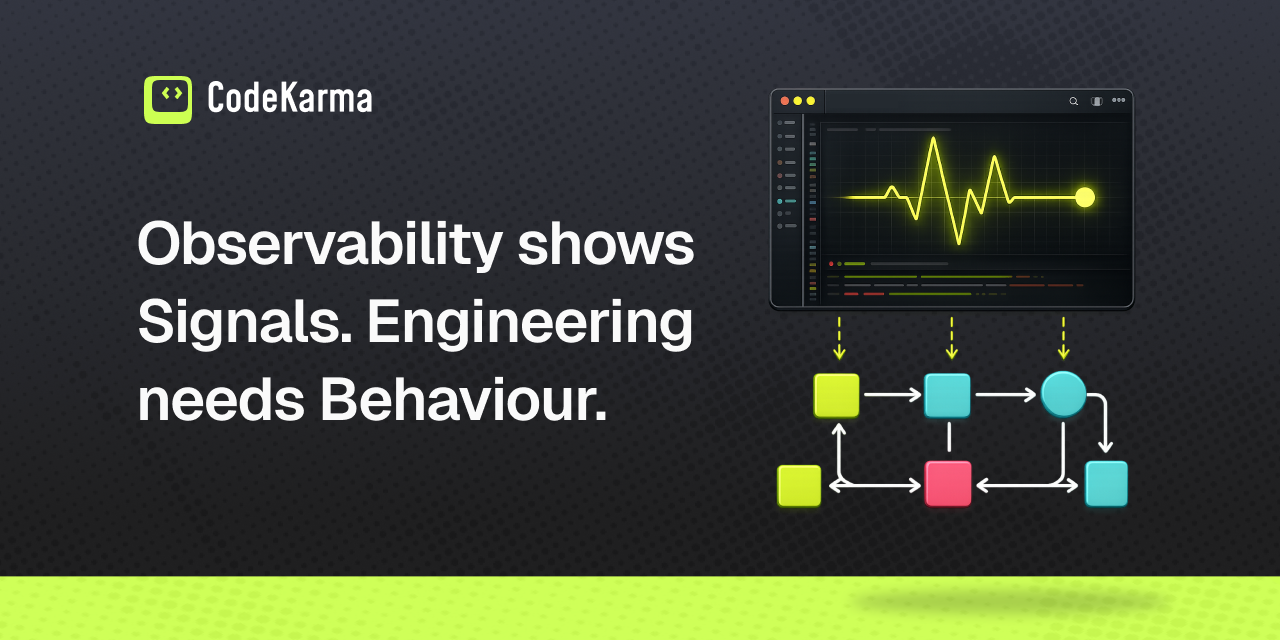
Observability Shows Signals. Engineering Needs Behaviour.

Observability Shows Signals. Engineering Needs Behaviour.

Observability tells teams when systems are unhealthy. Behavioural understanding tells them how systems actually work. The next engineering layer is not more dashboards — it is production-grounded context.

Read
AI Readiness Is Context Readiness

AI Readiness Is Context Readiness

A look at why most enterprise AI initiatives fail to move beyond demos. The missing layer is not better models, but reliable production context — the live system behaviour AI agents need to reason accurately about code, infrastructure, and operational decisions.

Read
From Signal-Based Observability to Behaviour-Based Engineering

From Signal-Based Observability to Behaviour-Based Engineering

A look at the shift from traditional observability toward behaviour-based engineering — where production behaviour becomes the foundation for development, architecture, migrations, and AI-assisted coding. The next generation of engineering tools will not just surface signals, but help teams understand how their systems actually work.

Read
Why Enterprise Software Decisions Stall

Why Enterprise Software Decisions Stall

A look at why enterprise software deals often stall despite strong technical interest. The real challenge is not convincing the first buyer — it is preserving the product’s value as it moves through finance, procurement, risk, and executive layers without losing clarity or urgency.

Read
The Future of Developer Productivity Is Production-Aware

The Future of Developer Productivity Is Production-Aware

A look at why the next leap in developer productivity won’t come from writing more code faster, but from understanding production systems better. As AI copilots automate syntax, the real bottleneck becomes context, confidence, and visibility into what code is actually doing in production.

Read
Why Technical Debt Becomes Invisible in Production Systems

Why Technical Debt Becomes Invisible in Production Systems

The teams that move fastest in the next decade will not be the ones with the cleanest code. They will be the ones who know which parts of their system are still earning their keep.

Read
Engineering Decisions Should Be Based on Behaviour, Not Assumptions

Engineering Decisions Should Be Based on Behaviour, Not Assumptions

CodeKarma is making behaviour cheap enough to consult that no serious change has to be argued from memory.

Read
The Cost of Misdiagnosis in Software Systems

The Cost of Misdiagnosis in Software Systems

Most expensive incidents are not expensive because of the fix. They are expensive because of the wrong theories that came first.

Read
Why Production Context Belongs Inside the IDE

Why Production Context Belongs Inside the IDE

A developer opens a file. The cursor lands on a method. The first question, almost always, is the same: Is this thing actually used?

Read
The Real Problem With Microservices Is Interpretation

The Real Problem With Microservices Is Interpretation

Every few years, someone declares micro-services a mistake. The argument is familiar. Too many services. Too many queues. Too many async hops. Too much coordination. Too much overhead. Bring back the monolith. It is a satisfying argument. It is also slightly off.

Read
Production Never Lies

Production Never Lies

Modern engineering teams are drowning in signals but starving for clarity. The next shift is from interpreting fragmented telemetry to understanding live production behaviour directly.

Read
Rethinking Observability
getting-started

Rethinking Observability

How at CodeKarma re-imagining observability in the era of LLMs?

Read
The Migration Nightmare
architecture

The Migration Nightmare

Every enterprise has legacy software that grows unmanageable over time. Re-architecture doesn't have to be a desperate move — with the right insights, it becomes a strategic choice.

Read
Schedule Call View Platform

Contact Us

codekarma.ai

curl https://codekarma.ai/blog.md

CodeKarma blog index

# Articles and updates from CodeKarma

> Engineering insights, product updates, and deep dives about production intelligence, observability, AI agents, and software architecture.

## metadata

path
/blog/
published_posts
22

## Published posts

  • Why Better Dashboards Don't Always Create Better Decisions: Dashboards centralise data. They do not centralise understanding.
  • The Missing Layer Between Code and Observability: Observability shows what the system emitted. Engineering needs to know what the system did.
  • Your Architecture Diagram Is Probably Lying: The most useful architecture view is the one the system writes itself.
  • Dead Code Is Not Just a Cleanup Problem: The point is not to delete more code. The point is to read the system you actually have, not the one the repository remembers.
  • Why Change Feels Risky in Distributed Systems: CodeKarma brings real production dependencies into the spot where changes are decided.
  • From Incident Response to Incident Understanding: You cannot fix a system faster than you can agree on what it is doing.
  • Why AI SRE Needs Ground Truth, Not Just More Telemetry: Faster interpretation is cheap. Better understanding is the work.
  • AI Will Write More Code. Who Will Understand It?: AI will write the code. Production will tell you what it actually built.
  • The Hidden Cost of Understanding Software: Production never lies. The cost of not listening to it is on every engineering invoice, just not labelled that way.
  • Observability Shows Signals. Engineering Needs Behaviour.: Observability tells teams when systems are unhealthy. Behavioural understanding tells them how systems actually work. The next engineering layer is not more dashboards — it is production-grounded context.
  • AI Readiness Is Context Readiness: A look at why most enterprise AI initiatives fail to move beyond demos. The missing layer is not better models, but reliable production context — the live system behaviour AI agents need to reason accurately about code, infrastructure, and operational decisions.
  • From Signal-Based Observability to Behaviour-Based Engineering: A look at the shift from traditional observability toward behaviour-based engineering — where production behaviour becomes the foundation for development, architecture, migrations, and AI-assisted coding. The next generation of engineering tools will not just surface signals, but help teams understand how their systems actually work.
  • Why Enterprise Software Decisions Stall: A look at why enterprise software deals often stall despite strong technical interest. The real challenge is not convincing the first buyer — it is preserving the product’s value as it moves through finance, procurement, risk, and executive layers without losing clarity or urgency.
  • The Future of Developer Productivity Is Production-Aware: A look at why the next leap in developer productivity won’t come from writing more code faster, but from understanding production systems better. As AI copilots automate syntax, the real bottleneck becomes context, confidence, and visibility into what code is actually doing in production.

  • Why Technical Debt Becomes Invisible in Production Systems: The teams that move fastest in the next decade will not be the ones with the cleanest code. They will be the ones who know which parts of their system are still earning their keep.
  • Engineering Decisions Should Be Based on Behaviour, Not Assumptions: CodeKarma is making behaviour cheap enough to consult that no serious change has to be argued from memory.
  • The Cost of Misdiagnosis in Software Systems: Most expensive incidents are not expensive because of the fix. They are expensive because of the wrong theories that came first.
  • Why Production Context Belongs Inside the IDE: A developer opens a file. The cursor lands on a method. The first question, almost always, is the same: Is this thing actually used?
  • The Real Problem With Microservices Is Interpretation: Every few years, someone declares micro-services a mistake. The argument is familiar. Too many services. Too many queues. Too many async hops. Too much coordination. Too much overhead. Bring back the monolith. It is a satisfying argument. It is also slightly off.
  • Production Never Lies: Modern engineering teams are drowning in signals but starving for clarity. The next shift is from interpreting fragmented telemetry to understanding live production behaviour directly.
  • Rethinking Observability: How at CodeKarma re-imagining observability in the era of LLMs?
  • The Migration Nightmare: Every enterprise has legacy software that grows unmanageable over time. Re-architecture doesn't have to be a desperate move — with the right insights, it becomes a strategic choice.
Human Agent