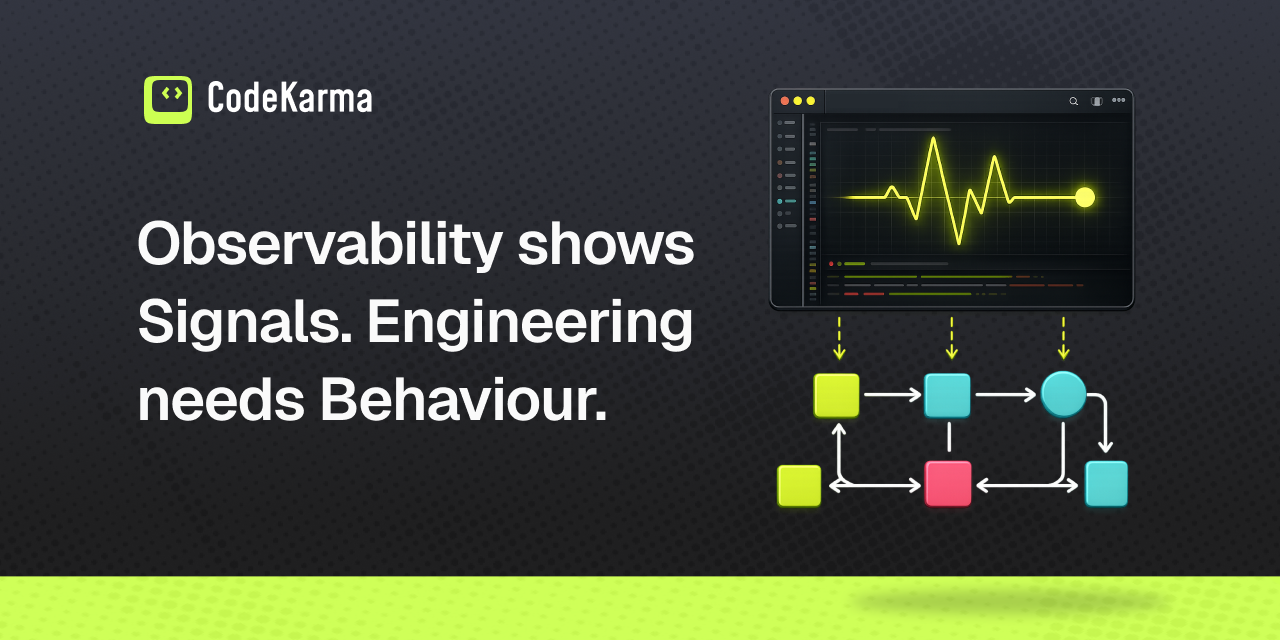
Observability Shows Signals. Engineering Needs Behaviour.
Observability is not the problem.
The problem is that we keep asking it to do a job it was never designed to do.
Observability was built for one core question, "Is the system healthy right now?"
Latency, error rates, traces, alerts, dashboards — all of it is tuned to surface anomalies fast and help an on-call engineer act before customers notice. That is a real job. It is also a narrow one.
Observability is a health check. Engineering needs a behavioural map.
Same Data, Different Question
A developer about to refactor a service does not need to know whether p99 spiked at 3am.
They need to know:
- Who calls this method
- Which flows depend on it
- Whether it is still used at all
- What breaks if they touch it
An architect planning a migration does not need a flame graph.
They need to know:
- Which services are actually connected in production
- Which queues carry real traffic
- Which dependencies exist on paper but not in reality
A leader prioritising technical debt does not need another dashboard.
They need to know:
- Which parts of the codebase are dormant
- Which are hot
- Where engineering effort actually lands
These are not monitoring questions. They are understanding questions.
Why Observability Tools Struggle Here
Observability data is optimised for incidents. It is high-cardinality, time-bounded, and indexed for "What is wrong now?"
Behavioural questions are different in shape.
-
They are slow questions.
-
They span weeks of traffic, not seconds.
-
They need to map runtime activity back to:
- APIs
- Methods
- Code paths
- Real dependencies
Not just a service ID and a timestamp.
You can sometimes coax behaviour out of observability tools, the way you can sometimes coax a spreadsheet out of a database.
It works until it does not. And the cost is the engineer’s time.
A Different Layer, Not a Replacement
Observability answers, "Is the system okay?"
Behaviour answers, "How does the system actually work?"
Both matter. Neither replaces the other.
But most teams have spent a decade building the first layer and almost nothing for the second.
Observability is necessary. Behavioural understanding is missing.
The Next Layer
The next layer is not another dashboard or another agent.
It is a view of the system grounded in what actually runs:
- Services
- APIs
- Methods
- Flows
- Real runtime dependencies
Usable inside:
- The IDE
- Architecture reviews
- Migration planning
- An AI agent’s context window
That layer is what CodeKarma is building. Not a replacement for observability. The thing that sits next to it and answers a different class of question.
The goal is not more signals. It is fewer assumptions.