Why Enterprise Software Decisions Stall
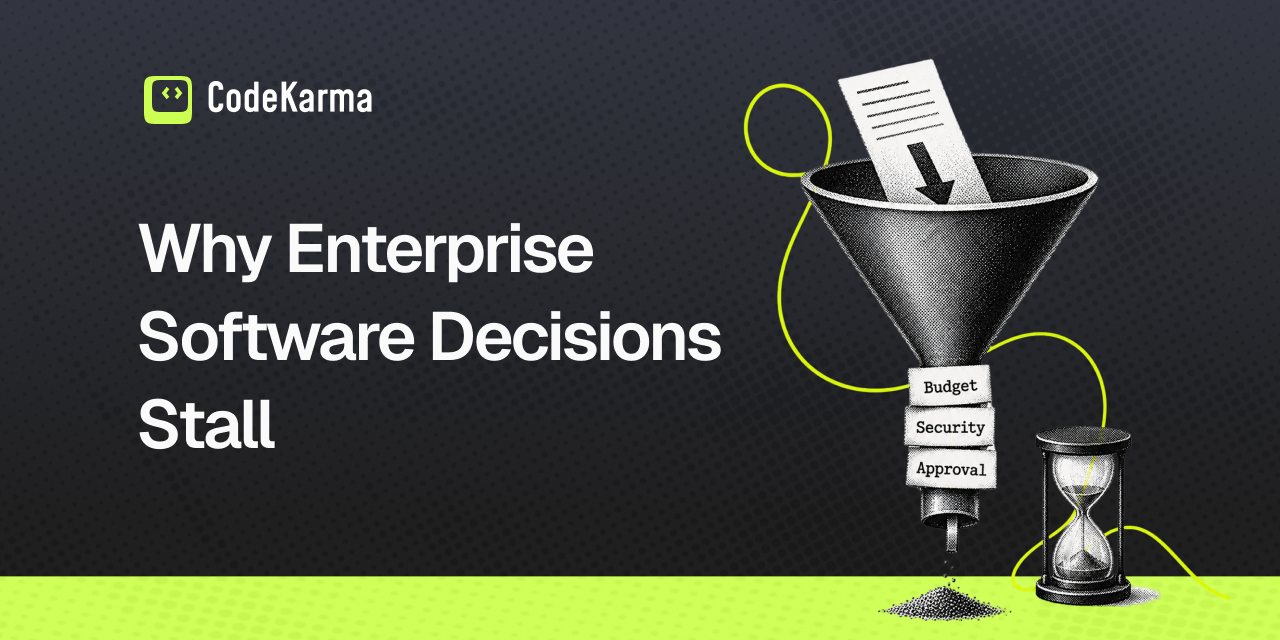
Most enterprise deals do not die from a lack of interest. They die in translation.
A technical champion gets it. They have lived the problem, they understand the product, they want it. They write the internal note. Then the note has to travel.
It travels to a budget owner who does not feel the pain. To a risk team that needs a different vocabulary. To procurement, which is comparing line items. To an executive who has eight other notes in the queue this quarter.
By the time the original conviction reaches the decision, most of its weight has been left along the way.
The bottleneck in enterprise software is not interest. It is value transmission.
Technical Wins Do Not Auto-Translate
Founders often confuse a strong technical demo with a strong business case.
They are not the same artefact.
A demo lives in a conversation with someone who already has the context. A business case lives in a one-page email forwarded to someone who does not.
The first survives nuance. The second does not.
When the demo wins and the deal stalls, the temptation is to blame the buyer.
The more useful question is what happened to the value between the champion's screen and the executive's inbox.
Usually, it got compressed into generic language:
- “Improves productivity”
- “Reduces risk”
- “Modernises the stack”
None of which carry the original signal.
The technical champion knows the product saves a team three weeks per migration. By the time that reaches finance, it reads as “efficiency gains.”
Efficiency gains do not get budget approved in Q4.
Designing for the Carry, Not the Close
The interesting design problem in enterprise GTM is not how to close.
It is how to make value carry through the building without losing fidelity.
That changes what founders should build and ship.
Not just product. Artefacts.
- A short note the champion can forward without rewriting
- A specific number the CFO can defend in a meeting
- A risk framing the security team can accept without a six-week review
- A one-line story that survives being told by someone who did not see the demo
Good GTM teams treat these as product.
They version them, watch where they fall apart, and tighten them.
Bad GTM teams write a deck once and hope.
The Shift
Enterprise decisions stall when the people who feel the pain are not the people who hold the budget.
The fix is not louder pitching.
It is shorter, sharper translation between layers.
Founders who internalise this stop optimising for “do they like the product.”
They start optimising for:
Can the value travel without me in the room?
The deals that close are not always the ones with the best technology.
They are the ones where the value did not lose its weight on the way up.
In enterprise software, the product gets you a meeting. Translation gets you the deal.